
Keto and intermittent fasting show up together constantly—in Reddit threads, YouTube videos, and doctor recommendations for metabolic health.
Here’s why: they work through complementary mechanisms. Keto shifts your body to burn fat for fuel. Intermittent fasting extends the time your body stays in fat-burning mode. Combined, they create a metabolic environment optimized for fat loss, insulin sensitivity, and cellular repair.
But combining keto and intermittent fasting isn’t just “do both at once.” Timing matters. Electrolytes become critical. The adaptation period intensifies. Some people thrive on the combination while others crash hard.
This guide explains exactly how keto and intermittent fasting work together, the benefits research documents, practical implementation schedules (especially the popular 16:8 method), who should avoid the combination, and how to start safely. You’ll also learn how this approach connects to Ramadan fasting for cultural context.
By the end, you’ll know whether keto and IF makes sense for your goals and how to implement it without the mistakes that derail most beginners. If you’re new to keto entirely, start with our comprehensive guide on what is the keto diet before combining it with fasting.
Let’s break down this powerful metabolic combination.
Understanding the Keto and Intermittent Fasting Synergy
Before implementing both strategies, understand how they complement each other metabolically.
What Is Intermittent Fasting?
Intermittent fasting (IF) controls when you eat rather than what you eat. You cycle between eating periods (feeding windows) and fasting periods (no calorie intake).
Common IF schedules:
16:8 Method (most popular)
- Fast: 16 hours daily
- Eat: 8-hour window
- Example: Eat 12 PM – 8 PM, fast 8 PM – 12 PM next day
18:6 Method
- Fast: 18 hours daily
- Eat: 6-hour window
- Example: Eat 2 PM – 8 PM, fast 8 PM – 2 PM next day
20:4 Method (advanced)
- Fast: 20 hours daily
- Eat: 4-hour window
- Example: Eat 4 PM – 8 PM, fast 8 PM – 4 PM next day
OMAD (One Meal A Day)
- Fast: 23 hours daily
- Eat: 1 meal consumed within 1 hour
- Example: Dinner at 6 PM, fast until 6 PM next day
During fasting windows, you consume zero calories—only water, black coffee, tea, or other non-caloric beverages.
How Keto and IF Work Together
The combination creates metabolic synergy through three mechanisms:
1. Extended Ketosis
Ketogenic diets produce ketones when carbohydrate intake stays below 20-50g daily. Intermittent fasting accelerates ketone production because:
- Fasting depletes remaining glucose stores faster
- Your body enters ketosis sooner after meals
- Ketone levels stay elevated longer between meals
Most people reach ketosis within 2-4 days on keto alone. Adding IF can reduce this to 12-24 hours.
2. Enhanced Fat Oxidation
Both strategies increase fat burning:
- Keto makes fat your primary fuel source
- Fasting creates energy deficit requiring fat breakdown
- Combined, your body becomes exceptionally efficient at mobilizing and burning stored fat
Research published in Cell Metabolism shows the combination increases fat oxidation rates 20-30% beyond either strategy alone.
3. Improved Insulin Sensitivity
Insulin resistance—when cells stop responding to insulin properly—drives Type 2 diabetes, weight gain, and metabolic dysfunction.
Keto reduces insulin needs by eliminating blood sugar spikes. Intermittent fasting gives your pancreas extended breaks from insulin production. Together, they powerfully improve insulin sensitivity—the hallmark of metabolic health.
A 2019 study in Obesity found participants combining keto and 16:8 IF improved insulin sensitivity 30% more than keto alone over 12 weeks.
Evidence-Based Benefits of Combining Keto and IF
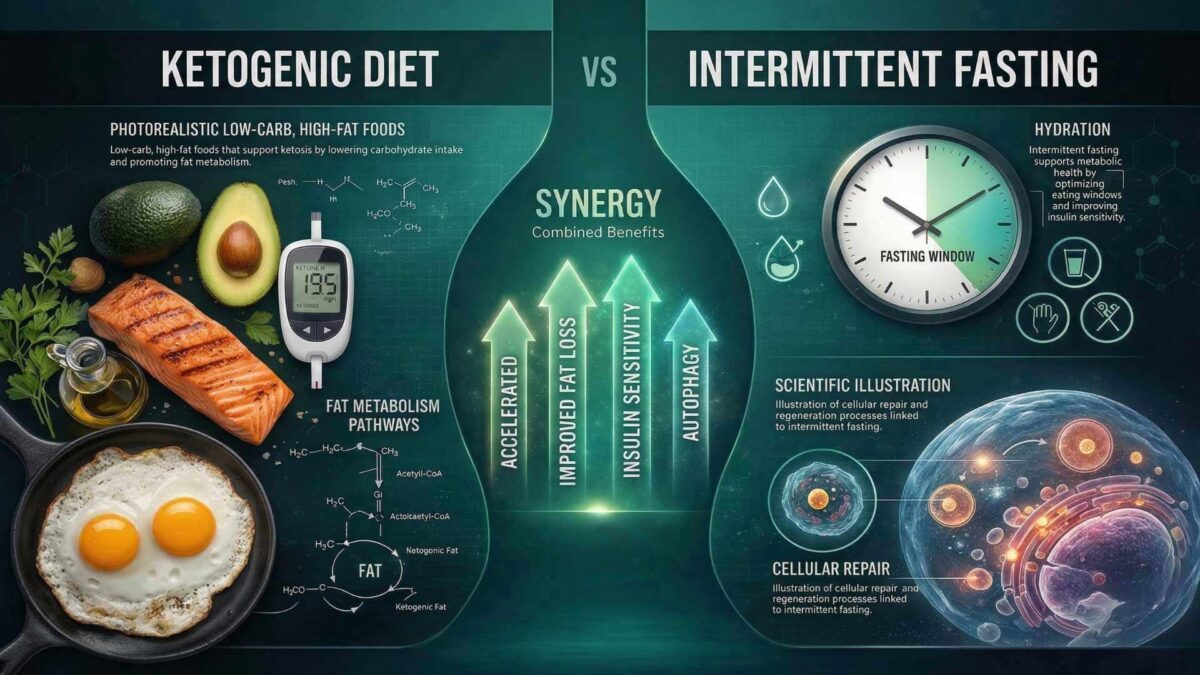
The synergy between keto and intermittent fasting isn’t just theoretical—when you understand the foundational metabolic shift that makes keto work, adding timed eating windows amplifies those effects naturally, which is why our what is the keto diet guide explains the metabolic mechanisms before diving into advanced strategies like IF.
Research documents specific advantages of the keto and IF combination:
Accelerated Weight Loss
Multiple studies show faster fat loss when combining approaches:
A 2020 study in Nutrients tracked 52 participants for 12 weeks. Results:
- Keto alone: Average 12.8 pounds lost
- IF alone: Average 10.2 pounds lost
- Keto + IF: Average 18.7 pounds lost
The combination produced 46% more weight loss than keto alone.
Why it works:
- Extended fasting periods increase fat oxidation time
- Lower insulin levels promote fat release from cells
- Reduced eating window often decreases total calorie intake naturally
- Ketones suppress appetite, making fasting easier
Improved Metabolic Markers
Clinical evidence shows superior metabolic improvements:
Blood Sugar Control:
- Fasting glucose decreases 15-25% on keto + IF vs. 10-15% on keto alone
- HbA1c (3-month blood sugar average) improves more significantly
- Post-meal blood sugar spikes virtually eliminated
Cardiovascular Risk Markers:
- Triglycerides drop 40-60% (vs. 30-50% keto alone)
- HDL cholesterol increases 15-20% (vs. 10-15% keto alone)
- Blood pressure reductions more pronounced (8-12 mmHg vs. 5-8 mmHg)
Research published in The Journal of Clinical Endocrinology & Metabolism found participants combining keto and 16:8 IF reduced cardiovascular disease risk markers 35% more than keto alone after 6 months.
Enhanced Autophagy and Cellular Repair
Autophagy—your body’s cellular “housekeeping” process—breaks down and recycles damaged cell components. Think of it as taking out the cellular trash.
Both keto and fasting independently trigger autophagy, but the combination creates particularly strong signals:
Fasting triggers autophagy through:
- Nutrient deprivation activating cleanup pathways
- Low insulin levels permitting cellular recycling
- Extended fasting periods (12+ hours) maximizing effect
Ketones enhance autophagy by:
- Beta-hydroxybutyrate (BHB) directly activating autophagy genes
- Reduced oxidative stress protecting cells
- Improved mitochondrial function
Research from Autophagy journal shows ketone levels above 0.5 mmol/L combined with 16+ hour fasts create optimal autophagy activation.
Potential benefits of enhanced autophagy:
- Cellular aging reduction (longevity effects)
- Improved brain health and neuroprotection
- Enhanced immune function
- Reduced inflammation markers
Note: Most autophagy research comes from animal studies. Human applications are promising but require more research.
Mental Clarity and Focus
Anecdotal reports consistently describe improved cognitive function on keto and IF. Preliminary research suggests mechanisms:
Ketones as brain fuel:
- More efficient energy production than glucose
- Reduced brain fog reported by 60-70% of users
- Stable energy without blood sugar crashes
Fasting-induced neuroplasticity:
- Brain-derived neurotrophic factor (BDNF) increases during fasting
- BDNF supports neuron growth and protection
- May improve learning and memory
A small 2018 study in Aging found participants combining keto and IF scored 23% higher on cognitive tests measuring focus and processing speed compared to baseline.
Important caveat: Adaptation takes 2-4 weeks. Initial mental fog is common before benefits emerge.
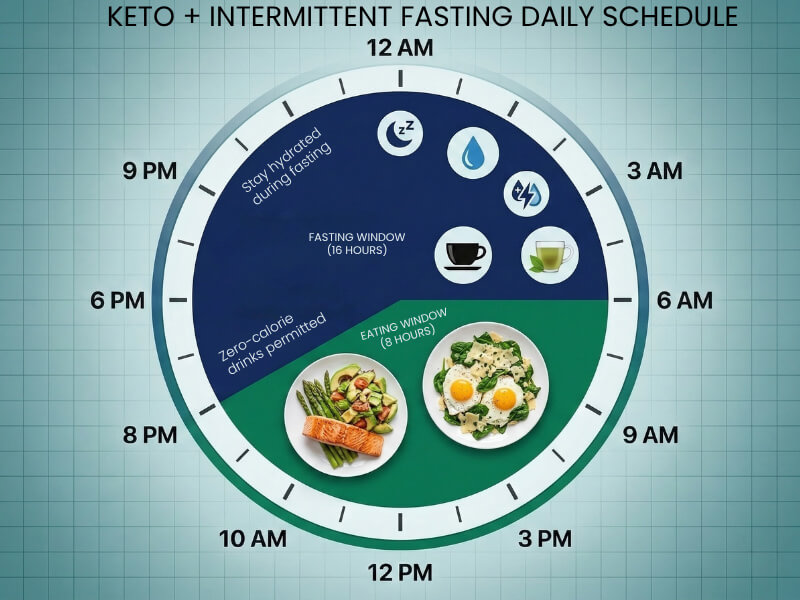
Successfully combining keto and intermittent fasting requires strategic timing and proper setup.
Starting Approach: Sequential vs. Simultaneous
Option 1: Sequential Introduction (Recommended for Beginners)
Start keto first, add IF later:
Weeks 1-3: Keto only
- Adapt to fat-burning metabolism
- Learn keto-friendly foods
- Establish meal preparation routine
- Avoid keto flu complications
Week 4+: Add intermittent fasting
- Start with 12:12 (12-hour fast, 12-hour eating window)
- Progress to 14:10 after 1 week
- Move to 16:8 when comfortable (usually week 6-8)
Why this works:
- Keto adaptation happens first (less overwhelming)
- Once fat-adapted, fasting feels natural (hunger decreases)
- Lower stress on your body (one change at a time)
- Higher long-term adherence rates
Option 2: Simultaneous Start (Advanced)
Begin both immediately if you:
- Have IF experience already
- Want maximum short-term results (special event, etc.)
- Handle dietary changes well mentally and physically
- Can manage more intense adaptation symptoms
Week 1: Start 16:8 IF + strict keto (<20g carbs)
- Expect more intense keto flu symptoms
- Electrolytes become absolutely critical
- Mental discipline required (no “easing in”)
Most people succeed better with sequential approach. Our how to start keto guide provides the foundation before adding IF complexity.
Choosing Your IF Schedule
16:8 Method – Best for Beginners
Eating window: 12 PM – 8 PM
Fasting window: 8 PM – 12 PM (next day)
Typical meal schedule:
- 12 PM (noon): First meal (break fast)
- 4 PM: Optional snack
- 7 PM: Dinner (last meal before 8 PM cutoff)
Advantages:
- Skipping breakfast feels natural for many people
- Social dinner preserved (family meals, dates)
- 8-hour eating window allows 2-3 comfortable meals
- Sleep counts toward fasting hours (easier adherence)
18:6 Method – Intermediate
Eating window: 2 PM – 8 PM
Fasting window: 8 PM – 2 PM (next day)
Typical meal schedule:
- 2 PM: First meal
- 7 PM: Dinner
Advantages:
- Deeper ketosis due to longer fast
- Usually only 2 meals needed (simplified)
- Stronger autophagy activation
- Better for insulin resistance reversal
Challenges:
- Skipping breakfast and lunch (social difficulty)
- Requires higher meal density (more calories per meal)
- Not ideal for heavy exercise mornings
20:4 or OMAD – Advanced Only
Only attempt after 3+ months success with 16:8 or 18:6.
These extreme approaches work for specific goals but create adherence and nutrient adequacy challenges most people can’t sustain long-term.
Sample Keto IF Meal Plan (16:8 Method)
Fasting Window (8 PM – 12 PM):
- 6 AM: Black coffee or tea
- 8 AM: Water with pinch of sea salt (electrolytes)
- 10 AM: Sparkling water or herbal tea
- 12 PM: Break fast
Eating Window (12 PM – 8 PM):
Meal 1 (12 PM) – Breaking Fast:
- 3 eggs scrambled in butter
- ½ avocado
- 2 cups spinach sautéed in olive oil
- Optional: 2 oz halal beef or turkey sausage
- Black coffee or tea (if desired)
Macros: ~500 calories, 35g fat, 30g protein, 8g net carbs
Meal 2 (4 PM) – Optional Snack:
- 2 oz macadamia nuts OR
- Celery with 2 tbsp almond butter OR
- String cheese + cherry tomatoes
Macros: ~250 calories, 20g fat, 8g protein, 5g net carbs
Meal 3 (7 PM) – Dinner:
- 6 oz grilled chicken thighs (halal)
- 2 cups broccoli roasted in olive oil
- Side salad with olive oil + vinegar
- ¼ cup shredded cheese
Macros: ~650 calories, 45g fat, 48g protein, 10g net carbs
Daily Totals: ~1,400 calories, 100g fat, 86g protein, 23g net carbs
Note: Adjust portions based on your individual calorie needs and activity level.
Critical Success Factors
1. Electrolyte Management (Non-Negotiable)
Combining keto and IF dramatically increases electrolyte needs:
Sodium: 5,000-7,000mg daily
- Add ½ tsp salt to morning water during fast
- Salt all meals generously
- Drink bone broth or bouillon
Potassium: 3,500-4,500mg daily
- Avocados (1 medium = 700mg)
- Spinach (3 cups cooked = 840mg)
- Salmon (6 oz = 720mg)
- Supplement if needed (check with doctor)
Magnesium: 400-500mg daily
- Pumpkin seeds, almonds, dark chocolate
- Supplement magnesium glycinate at bedtime
Inadequate electrolytes cause: headaches, muscle cramps, fatigue, dizziness, irregular heartbeat.
2. Hydration During Fasting
Target: 10-14 cups water daily (more if exercising)
Fasting window protocol:
- Morning: 2 cups water with pinch of salt
- Mid-morning: 2 cups plain water or herbal tea
- Late morning: 2 cups water
- During eating window: 4-6 more cups
Allowed during fasting window:
- Water (plain or sparkling)
- Black coffee (no cream, sugar, or butter)
- Plain tea (green, black, herbal)
- Apple cider vinegar in water (1-2 tbsp)
- Electrolyte supplements (zero-calorie only)
Not allowed (breaks fast):
- Any food
- Cream, milk, or half-and-half
- Butter or MCT oil in coffee
- Protein shakes
- Bone broth (contains calories/protein)
- Diet sodas (debated—some say acceptable, others say artificial sweeteners trigger insulin)
3. Protein Adequacy
Shortened eating windows create protein timing challenges.
Minimum protein: 0.8-1.0g per pound body weight daily
Example: 150-pound person needs 120-150g protein daily
Strategy for 16:8 window:
- Meal 1: 30-40g protein
- Meal 2: 30-40g protein
- Meal 3: 50-60g protein
- Total: 110-140g (adequate)
If struggling to hit protein:
- Prioritize protein-dense foods (meat, fish, eggs)
- Consider protein shake during eating window
- Extend eating window to 18:6 or 20:4 (allows larger meals)
4. Training and Exercise Timing
Fasted training (during fasting window):
Advantages:
- Enhanced fat oxidation
- Elevated growth hormone
- Deeper ketosis
Disadvantages:
- Reduced high-intensity performance
- Glycogen-depleted (affects strength/power)
- Requires fat adaptation (2-6 weeks minimum)
Fed training (during eating window):
Advantages:
- Better performance for strength/HIIT
- Protein available for muscle recovery
- More comfortable for beginners
Recommendation:
- Beginners: Train during eating window (1-2 hours after meal)
- Advanced/fat-adapted: Experiment with fasted training
- Heavy lifting: Train fed (glycogen matters for strength)
- Endurance training: Fasted training often works well
Potential Challenges and How to Manage Them
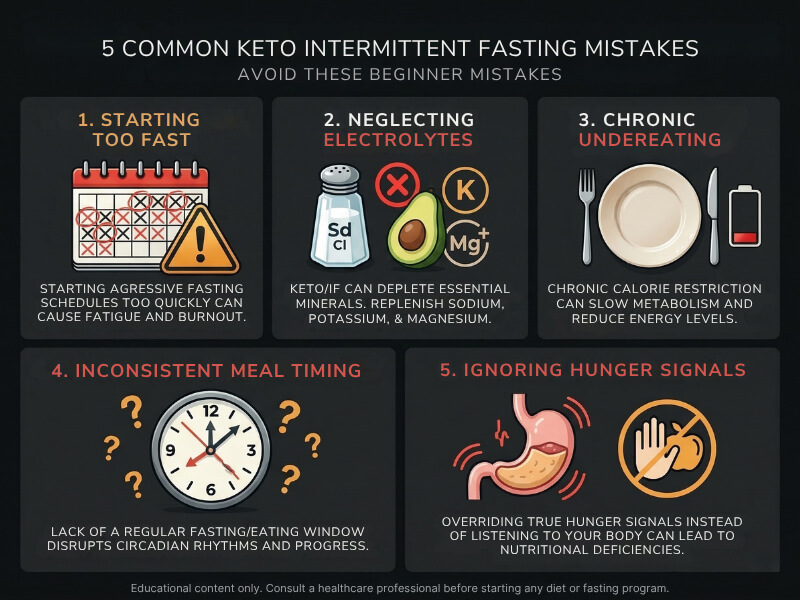
Most keto IF challenges stem from rushing the process—successful implementation requires understanding your body’s signals and adjusting gradually, which is exactly why starting with keto fundamentals through our how to start keto guide before adding fasting complexity prevents the overwhelming adaptation symptoms that derail most beginners.
Combining keto and IF intensifies certain challenges. Here’s how to navigate them:
Intensified Keto Flu
The problem:
IF + keto together can worsen first-week symptoms:
- More severe headaches
- Greater fatigue
- Intensified brain fog
- Stronger muscle cramps
The solution:
Electrolyte protocol (critical):
- Morning fasting: 2 cups water + ½ tsp sea salt
- Throughout day: 10-12 cups water minimum
- With meals: Salt food aggressively
- Evening: Magnesium supplement (400mg)
- Consider: Potassium supplement (consult doctor first)
Gradual approach:
- Week 1-2: Keto only (no fasting)
- Week 3-4: Add 12:12 IF (gentle introduction)
- Week 5+: Progress to 16:8 when comfortable
Adequate calories:
- Don’t restrict calories during first 3 weeks
- Focus on carb restriction and meal timing only
- Let appetite naturally decrease before cutting portions
Extreme Hunger in Early Weeks
The problem:
Before fat adaptation, fasting windows feel torturous. Hunger hormones spike intensely around usual meal times.
The solution:
Week 1-2 strategies:
- Start with 14:10 window (not 16:8)
- Drink water aggressively when hunger hits
- Black coffee or tea suppresses appetite
- Distract yourself (walk, work, hobby)
- Remember: Hunger comes in waves, then passes
After week 3-4 (fat-adapted):
- Hunger during fasting drops dramatically
- Ketones suppress ghrelin (hunger hormone)
- Fasting becomes surprisingly easy
- Many report zero hunger in fasting window
If hunger persists beyond 4 weeks:
- Increase healthy fats at last meal (avocado, olive oil, nuts)
- Ensure adequate protein (0.8-1.0g per pound body weight)
- Check if you’re actually in ketosis (test ketones)
- Consider 14:10 or 16:8 may not suit you (that’s okay!)
Undereating and Nutrient Deficiency
The problem:
Compressed eating windows + appetite suppression can lead to inadequate calories and nutrition.
Signs of undereating:
- Excessive fatigue beyond week 3
- Hair loss (after 3-4 months)
- Missed menstrual periods (women)
- Cold intolerance
- Workout performance decline (beyond adaptation period)
The solution:
Track initially:
- Use app (MyFitnessPal, Cronometer) for first 2 weeks
- Verify you’re hitting minimum calorie needs
- For women: Minimum 1,200-1,400 calories daily
- For men: Minimum 1,500-1,800 calories daily
- Active individuals: Add 300-500 calories
Nutrient-dense focus:
- Prioritize: Fatty fish, organ meats, eggs, leafy greens
- Don’t skip: 4-6 cups vegetables daily (fiber + micronutrients)
- Include: Nuts, seeds, avocados (nutrient density)
- Supplement: Multivitamin if concerned about gaps
Adjust eating window if needed:
- 16:8 too restrictive? Try 14:10
- Can’t eat enough in 8 hours? Extend to 10 hours
- Quality of life > perfect IF schedule
Social and Lifestyle Challenges
The problem:
Fasting windows conflict with social meals, family dinners, work lunches.
The solution:
Flexible scheduling:
- Adjust eating window based on social calendar
- Example: Dinner party at 8:30 PM? Shift window to 2 PM – 10 PM that day
- Weekend flexibility: Relax to 14:10 for brunch with friends
- Consistency matters more than perfection
Communication strategies:
- “I’m not hungry yet” (simple, no explanation needed)
- “I eat later in the day” (if pressed)
- “Doctor recommended this eating schedule” (ends questions)
- Bring keto-friendly dish to gatherings (ensures options)
Coffee meeting workaround:
- Morning coffee meeting during fasting window? Black coffee is fine
- Order black coffee, Americano, or tea
- Skip the muffins/pastries (politely decline)
Who Should NOT Combine Keto and Intermittent Fasting
While generally safe for healthy adults, specific populations should avoid the combination:
Absolute Contraindications:
1. History of eating disorders
- Restrictive eating patterns can trigger disordered behaviors
- IF + keto together create high-risk environment
- Mental health > any diet approach
2. Pregnant or breastfeeding women
- Fetus/infant require consistent nutrient availability
- IF conflicts with pregnancy nutritional demands
- Keto alone already questionable during pregnancy
- Wait until after breastfeeding concludes
3. Children and adolescents (under 18)
- Growing bodies need consistent nutrition
- Exception: Medical supervision for epilepsy treatment only
4. Type 1 diabetes
- Ketoacidosis risk becomes dangerous
- Requires endocrinologist supervision if attempting
- Medication timing complications with IF
- Never attempt without medical approval
Requires Medical Supervision:
5. Type 2 diabetes on medications
- Blood sugar can drop dangerously (hypoglycemia risk)
- Diabetes medications need adjustment
- Doctor must modify insulin/sulfonylurea doses
- Requires frequent glucose monitoring
6. Taking blood pressure medications
- Keto + IF significantly lowers blood pressure
- Medications may need reduction/elimination
- Risk of dangerously low BP without adjustment
7. Chronic kidney disease
- Fasting stresses compromised kidneys
- Protein timing becomes critical
- Requires nephrologist consultation
Exercise Caution:
8. Athletes in-season
- Performance likely suffers during adaptation (4-8 weeks)
- Consider off-season timing for IF introduction
- Monitor training metrics closely
9. Physically demanding jobs
- Construction, manual labor, nursing (long shifts)
- Fasting may impair safety/performance
- Consider modified approach or different strategy
10. High stress or poor sleep
- IF adds metabolic stress
- Fix sleep and stress first
- Adding IF when already stressed often backfires
Keto and Intermittent Fasting for Ramadan
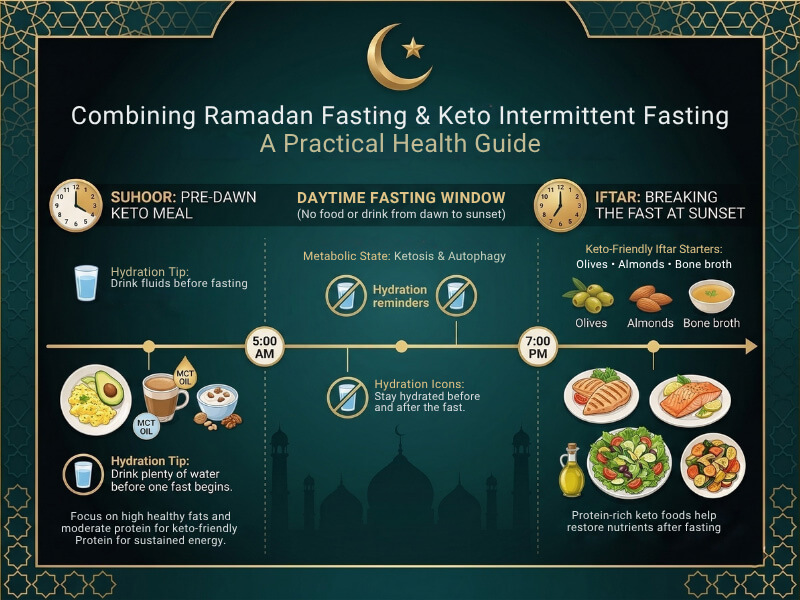
For Muslim readers, Ramadan fasting offers a natural introduction to intermittent fasting combined with ketogenic eating.
Ramadan Fasting Structure
Fasting window: Sunrise (Fajr) to sunset (Maghrib)
Eating window: Sunset to pre-dawn (Iftar to Suhoor)
Depending on location and season, fasting windows range from 12-18 hours daily—similar to 16:8 or 18:6 IF protocols.
Keto During Ramadan: Strategic Approach
Suhoor (Pre-Dawn Meal) Strategy:
Timing: As close to Fajr (dawn) as possible
Goal: Sustained energy and satiety through fasting hours
Ideal Suhoor composition:
- High-fat, moderate-protein, very low-carb
- Emphasize foods that digest slowly
- Prioritize hydration
Sample Suhoor menu:
- 3 eggs cooked in ghee or butter
- ½ avocado
- 2 cups spinach sautéed in olive oil
- 2 oz halal beef or lamb
- Water with electrolyte supplement
- Black coffee or tea (optional)
Macros: ~500 calories, 38g fat, 32g protein, 6g net carbs
Why this works:
Fat and protein provide 6-8 hours sustained energy without blood sugar crashes that carb-heavy Suhoor creates.
Iftar (Sunset Meal) Strategy:
Breaking the fast:
- Traditional: Dates and water (quick energy)
- Keto-adapted: 2-3 dates maximum (12-18g carbs), then wait 20 minutes
- Follow with keto-friendly meal
Main Iftar meal (after Maghrib prayer):
- Grilled halal meat (chicken, lamb, beef)
- Large salad with olive oil dressing
- Roasted low-carb vegetables (cauliflower, zucchini, eggplant)
- Healthy fats (olive oil, nuts, avocado)
Later evening (8-10 PM):
- Small protein/fat snack if hungry before Suhoor
- Ensures adequate daily nutrition
Hydration is critical:
- 8-10 cups water between Iftar and Suhoor
- Electrolyte supplementation (sodium, potassium, magnesium)
- Dehydration significantly worsens during Ramadan + keto
Adaptation Considerations
First 3-5 days of Ramadan:
Expect intensified adaptation if starting keto simultaneously. Consider starting keto 2-3 weeks before Ramadan begins for smoother transition.
Energy levels:
Fat-adapted individuals report better Ramadan fasting experience—stable energy, reduced hunger, maintained focus during daylight hours.
Spiritual benefits alignment:
Many report enhanced spiritual clarity on keto during Ramadan, attributing it to stable blood sugar and ketone-fueled mental focus.
Important: Ramadan fasting is a spiritual practice. Consult with your healthcare provider and religious advisor to ensure this approach aligns with your health needs and religious obligations. Those with medical conditions should prioritize health and may be exempt from fasting.
For comprehensive Ramadan-specific keto guidance, we’ll provide a detailed guide in our upcoming Ramadan keto article (Month 5).
Tracking Progress and Adjusting Your Approach
Successful long-term adherence requires monitoring and adjustment.
Key Metrics to Track
Weekly measurements:
- Body weight (same day/time weekly)
- Body measurements (waist, hips, chest)
- Progress photos (front, side, back)
- Energy levels (1-10 scale)
- Hunger during fasting (1-10 scale)
Monthly assessments:
- Blood ketone levels (optional but informative)
- Workout performance metrics
- Sleep quality changes
- Mood and mental clarity
Every 3 months:
- Blood work (lipid panel, metabolic panel, HbA1c)
- Compare to baseline pre-keto measurements
- Adjust approach based on results
When to Modify Your Approach
Signs to extend eating window:
- Persistent extreme hunger beyond 4 weeks
- Workout performance declining after 6-8 weeks
- Social life suffering significantly
- Hair loss or menstrual changes (women)
Solution: Move from 16:8 to 14:10 or 18:6
Signs to take an IF break:
- Obsessive food thoughts
- Extreme stress about meal timing
- Disordered eating patterns emerging
- Metabolic adaptation (weight loss plateau beyond 4-6 weeks)
Solution: Return to keto without IF for 2-4 weeks, then reassess
Signs the combination is working:
- Steady fat loss (1-2 lbs weekly after month 1)
- Reduced hunger during fasting windows
- Improved energy and mental clarity
- Better metabolic markers in bloodwork
- Sustainable long-term (doesn’t feel like suffering)
Getting Started: Your First 30 Days
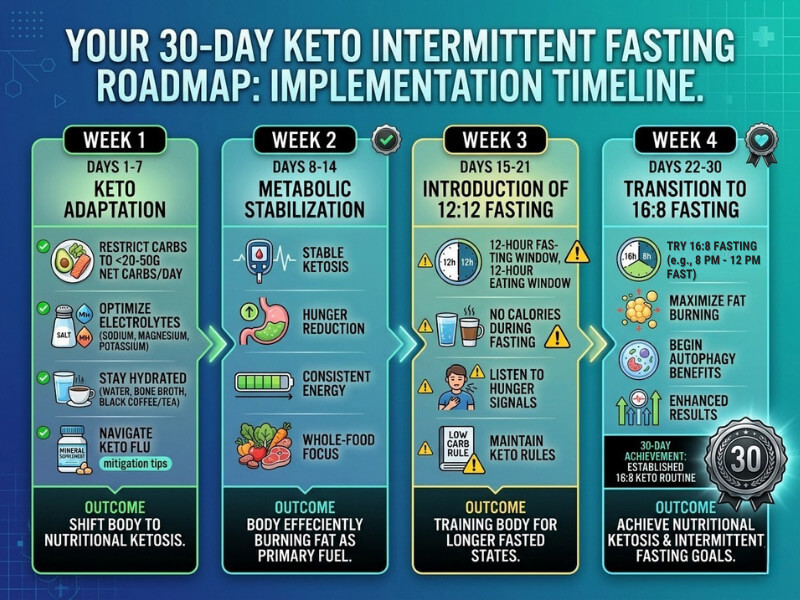
Week 1-2: Keto Foundation
Focus: Establish ketosis, not fasting
Daily protocol:
- Carbs: Under 20g net daily
- Protein: 0.8-1.0g per pound body weight
- Fat: To satiety
- Eat 3 meals whenever hungry (no time restriction yet)
- Hydration: 10+ cups water daily
- Electrolytes: 5,000mg sodium, 3,000mg potassium, 400mg magnesium
Goals:
- Enter ketosis (blood ketones 0.5+ mmol/L by day 3-5)
- Learn keto food options
- Manage keto flu symptoms
- Establish meal prep routine
Week 3: Introduction to IF
Focus: Gentle fasting introduction
Daily protocol:
- Continue strict keto macros
- Implement 12:12 fasting schedule
- Eating window: 8 AM – 8 PM
- Fasting window: 8 PM – 8 AM (next day)
- This is simply: No eating after dinner, no late-night snacks
- Continue 3 meals within 12-hour window
Goals:
- Adjust to “no snacking” mindset
- Experience mild fasting (barely noticeable)
- Build confidence for progression
Week 4: Progress to 16:8
Focus: Standard IF implementation
Daily protocol:
- Continue strict keto macros
- Implement 16:8 fasting schedule
- Eating window: 12 PM – 8 PM
- Fasting window: 8 PM – 12 PM (next day)
- Skip breakfast (coffee/tea only until noon)
- Reduce to 2-3 meals within 8-hour window
Goals:
- Complete first full week of 16:8
- Notice reduced hunger during fasting (if fat-adapted)
- Establish sustainable routine
Day 30 Assessment:
Evaluate:
- Total weight lost (expect 8-15 pounds)
- Energy levels (should be improving significantly)
- Hunger management (fasting should feel easier)
- Adherence percentage (aim for 80%+ days successful)
- Blood ketone levels (should be 0.5-3.0 mmol/L consistently)
Decide next steps:
- Continue 16:8 indefinitely? (most sustainable)
- Progress to 18:6? (deeper results)
- Adjust based on personal response
Ready to Make Keto IF Simple?
Combining keto and intermittent fasting works best with structured meal plans that fit your fasting window perfectly.
Get personalized 8-week keto meal plans optimized for your fasting schedule, food preferences, and goals.
- Exact recipes
- Shopping lists included
- Macro-calculated meals
- Works with 16:8, 18:6, and OMAD
Customizable for 16:8, 18:6, or OMAD schedules. Halal protein options available.
Supplements That Support Keto and IF
While whole foods should provide most nutrition, specific supplements optimize the combination:
Essential:
Electrolytes (critical importance)
- Sodium: Sea salt, Himalayan salt, electrolyte powder
- Potassium: Supplement or potassium-rich foods
- Magnesium: Glycinate or citrate form (400mg daily)
Highly Beneficial:
Omega-3 Fatty Acids
- Fish oil or algae oil
- Supports inflammation reduction
- Cardiovascular health protection
- Recommended: 1,000-2,000mg EPA+DHA daily
Vitamin D3
- Many people deficient (especially if keto indoors/limited sun)
- Supports immune function, bone health
- Recommended: 2,000-5,000 IU daily (test levels first)
Consider:
Digestive Enzymes
- Lipase (fat digestion)
- Protease (protein digestion)
- Helpful if experiencing digestive issues with high-fat meals
MCT Oil
- Medium-chain triglycerides (rapid ketone production)
- Can enhance ketosis depth
- Use sparingly: Start 1 tsp, max 1-2 tbsp daily (digestive tolerance)
- Take during eating window only (breaks fast if consumed during fasting)
Exogenous Ketones (optional, not necessary)
- Expensive
- Not required for ketosis
- May help mental clarity during adaptation
- Marketing often overstates benefits
Boost Your Fasted Mornings
Java Burn is a metabolism-supporting coffee enhancer designed for fasted states. It contains ingredients that may support fat oxidation and energy during your morning fasting window—without breaking your fast.
- Supports metabolism while fasting
- Helps reduce hunger naturally
- Zero calories, sugar, or carbs
- Convenient single-serve packets
Mix with black coffee during fasting window. Keto-friendly and fasting-compatible.
Frequently Asked Questions
Can I drink coffee during my fasting window?
Yes, black coffee is permitted and encouraged during fasting windows. Coffee contains zero calories, won’t spike insulin, and actually helps suppress appetite through caffeine. Many people find black coffee makes fasting significantly easier.
What’s allowed: Black coffee (no additions)
What breaks fast: Cream, milk, butter, MCT oil, sugar, artificial sweeteners (debated)
Plain tea, sparkling water, and water with electrolytes (zero-calorie) are also acceptable.
Will keto and IF slow my metabolism?
No, short-term fasting (16-20 hours) does not slow metabolism. Research shows metabolic rate remains stable or slightly increases during fasting periods up to 48 hours due to adrenaline and growth hormone elevation. Keto preserves muscle mass (which drives metabolism) better than calorie restriction alone.
Metabolism concerns arise with chronic severe calorie restriction (eating too little for extended periods), not with proper keto IF implementation where you eat adequate calories within a compressed window.
How long until I see results?
Week 1-2: Water weight loss (5-10 pounds), initial fat loss beginning
Week 3-4: Noticeable fat loss (1-2 lbs weekly), energy improves significantly
Week 6-8: Substantial visual changes, metabolic markers improving
Month 3-6: Major transformations, sustainable fat loss, optimal metabolic health
Fat adaptation (where fasting feels easy) typically occurs weeks 3-6. Initial results are motivating, but the real magic happens months 2-6 as your body becomes exceptionally efficient at fat burning.
Can I exercise while fasting?
Yes, but timing and intensity matter. Light-to-moderate exercise during fasting windows works well—walking, yoga, light cardio. High-intensity training or heavy lifting performs better during eating windows (1-2 hours after meal) when glycogen and protein are available.
Fasted training advantages include enhanced fat oxidation and growth hormone release. Disadvantages include reduced performance for strength and power activities. Experiment to find what works for your goals and training style.
What if I get hungry during my fasting window?
First 1-3 weeks (adaptation): Hunger is normal and expected. Strategies: drink water aggressively (2-3 cups when hunger hits), black coffee or tea, distract yourself (hunger comes in waves), remember it gets dramatically easier after fat adaptation.
After week 4+ (fat-adapted): Hunger during fasting should decrease significantly. If persistent hunger continues beyond 4 weeks, troubleshoot: Are you eating enough during eating window? Getting adequate fat and protein? Actually in ketosis? Consider extending eating window to 14:10 if 16:8 is unsustainable.
Is keto and IF safe long-term?
Research supports safety for 6-24 months based on clinical trials. Longer-term data (3+ years) is limited but case reports and populations practicing similar patterns (traditional fasting cultures) show no inherent problems.
Key to long-term safety: adequate nutrition during eating windows, regular blood work monitoring (every 6-12 months), listening to your body (adjust if concerning symptoms), and maintaining this as a sustainable lifestyle rather than extreme restriction.
Some practitioners recommend cyclical approaches (6 months strict, 2-3 months relaxed) for very long-term adherence.
Can women do keto and IF safely?
Yes, but women often need modifications. Women’s hormones are more sensitive to calorie restriction and fasting stress than men’s. Recommendations for women:
Start with gentler approach (14:10 before 16:8)
Ensure adequate calories (don’t combine IF with severe restriction)
Monitor menstrual cycle changes (irregular periods signal overreaching)
Consider carb cycling around menstruation (add 30-50g carbs 3 days before period)
Prioritize sleep and stress management
If cycles stop for 3+ months, discontinue IF and consult a doctor.
Pregnant and breastfeeding women should avoid both keto and IF until after nursing concludes.
Conclusion: Is Keto and Intermittent Fasting Right for You?
Keto and intermittent fasting create powerful metabolic synergy—accelerated fat loss, improved insulin sensitivity, enhanced cellular repair, and mental clarity that surpass either strategy alone.
The combination works best for:
- People already keto-adapted seeking enhanced results
- Those with significant weight loss goals (30+ pounds)
- Individuals reversing metabolic dysfunction (prediabetes, insulin resistance)
- Busy professionals wanting simplified eating (fewer meals, less meal prep)
- Anyone struggling with constant hunger on traditional diets
The combination may not suit:
- Eating disorder history or risk
- Pregnancy, breastfeeding, or trying to conceive
- Type 1 diabetes without medical supervision
- High stress or poor sleep (fix these first)
- People who genuinely love breakfast and find skipping it miserable
The sustainable approach:
Start sequentially, not simultaneously. Master keto fundamentals first—our keto meal prep guide helps establish routines before adding IF complexity. Then introduce fasting gradually: 12:12 for a week, 14:10 for a week, then 16:8.
Prioritize electrolytes, adequate protein, and nutrient-dense whole foods during eating windows. Track progress through measurements and blood work, not just scale weight.
Most importantly: this should enhance your life, not dominate it. If keto and IF creates stress, obsession, or suffering beyond the initial 3-4 week adaptation, it’s not the right approach for you—and that’s completely okay. The best diet is one you can sustain long-term while feeling healthy, energetic, and satisfied.
For those who find their rhythm with keto and IF, it becomes an effortless lifestyle producing remarkable metabolic health improvements that extend far beyond weight loss.
