
INTRODUCTION
Lazy keto vs strict keto.
Which one actually works for weight loss? If you’re standing at this crossroads right now, you’re not alone. The strict path promises precision—track every macro, weigh every meal, hit those exact numbers. The lazy route? Just one rule: keep carbs low. That’s it.
Here’s the thing nobody tells you upfront: In the lazy keto vs strict keto world, you want results without making keto feel like a second job. You’ve heard it works. You know people who’ve lost serious weight. But the details? Overwhelming. Track macros? Calculate percentages? Weigh avocados? It sounds exhausting.
Then someone mentions “lazy keto.” Wait—there’s an easier way?
This isn’t about choosing the “best” method because honestly, there isn’t one. It’s about finding YOUR method. The approach that fits your brain, your schedule, your personality. Not your neighbor’s. Not some fitness influencer’s. Yours.
We’re breaking down lazy keto vs strict keto with zero fluff—just what works, what doesn’t, and how to decide. No judgment. No complicated science lectures. Just clarity.
Let’s settle this.
🎁 Confused About Which Keto Method to Choose?
Get our FREE Keto Method Comparison Guide with decision flowchart,
pros/cons breakdown, and personalized recommendations based on your
lifestyle and goals.
We respect your privacy. Unsubscribe anytime.
What is Strict Keto? Precision as a Strategy
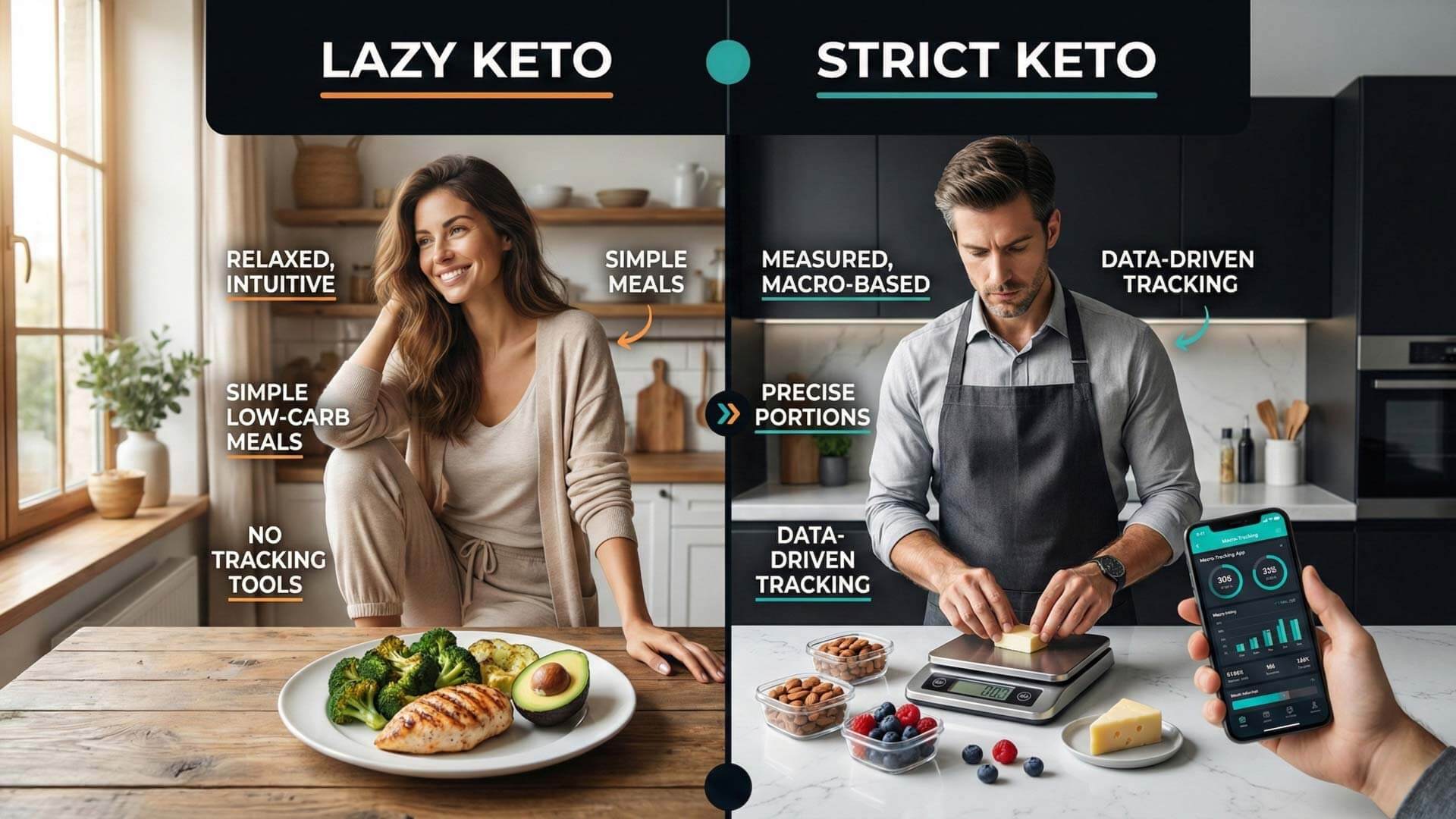
Think of strict keto like following GPS with exact coordinates. Turn-by-turn directions. No guessing.
You’re tracking everything. And we mean everything.
That chicken breast? Weighed. The olive oil you drizzled? Measured. Those three cherry tomatoes? Logged. Apps like Cronometer or Carb Manager become your constant companions. According to research from the National Institutes of Health, this precision creates metabolic consistency—your body knows exactly what’s coming, day after day.
Here’s the framework:
Every bite gets logged. You weigh portions on a digital food scale because eyeballing doesn’t cut it. A “handful” of almonds could be 6 grams of carbs or 12. Big difference when you’re aiming for 20 grams total.
Your macro targets are specific. Typically 70-75% fat, 20-25% protein, 5-10% carbs. These aren’t suggestions—they’re daily goals you hit religiously. Most people cap net carbs at 20 grams to guarantee ketosis.
Many strict keto followers test their ketone levels. Blood meters, breath analyzers, or urine strips confirm you’re actually burning fat for fuel. The target? 0.5-3.0 mmol/L blood ketones. It’s data-driven validation.
Meal planning is mandatory. Sunday becomes prep day. You calculate macros in advance, portion everything into containers, and pack lunches with mathematical precision.
The goal? Metabolic precision. Zero ambiguity. When you know exactly how long it takes to enter ketosis, you can optimize every single variable for faster results.
Nothing left to chance.

What is Lazy Keto? Simplicity as a System
Now picture using a compass instead of GPS.
You know the direction—low carb. You head that way. The specific route? Flexible.
Lazy keto is beautifully simple: keep net carbs under 20-25 grams daily. Don’t worry about the rest.
No calorie counting. No weighing chicken breasts. No apps tracking every gram of fat. You eat keto-friendly whole foods—meat, fish, eggs, vegetables, healthy fats—until you’re naturally satisfied. Many people don’t even use apps. They memorize which foods are keto-friendly and just… eat them.
Portion control? Your hunger handles it. Protein and fat are incredibly filling, so most people naturally consume fewer calories without the mental gymnastics of tracking.
The mental load drops dramatically. No food scales cluttering your kitchen. No calculating before every meal. No guilt over going 2 grams over your fat macro.
You simply eat real, whole foods that keep carbs low. For many beginners just learning how to start keto, this approach cuts overwhelm in half.
You’re in the ballpark. Not pinned to a specific seat.

Lazy Keto vs Strict Keto: The Core Difference Explained
Let’s watch two people make dinner.
Person A (strict keto): Pulls out the food scale. Weighs exactly 150g of chicken thigh—that’s 28g protein, 14g fat, precisely calculated. Measures one tablespoon of avocado oil. Fourteen grams of fat, 120 calories. Logs it all. The side of roasted broccoli brings the daily total to 18g net carbs. Perfect. They’ve hit their 120g protein target and will fill remaining calories with fat. Everything’s documented.
Person B (lazy keto): Cooks a chicken thigh in oil. Loads up on broccoli. Tosses some shredded cheese on top. Eats until comfortably full. No measurements. No apps. Just knows everything on that plate is low-carb, so it’s good to go.
One tracks inputs with mathematical precision. The other manages a single lever: keep carbs low.
This fundamental difference in the lazy keto vs strict keto debate shapes everything—your weight loss speed, your stress levels, your long-term success.
This lazy keto vs strict keto split? It affects everything from your grocery shopping to your stress levels.
Understanding the lazy keto vs strict keto distinction helps you make smarter choices about your approach from day one.
Weight Loss Showdown: Which Method Is More Effective?
So here’s the million-dollar question in the lazy keto vs strict keto debate: which one actually wins for shedding pounds?
Frustrating answer? It depends.
Not on the methods themselves—both work. It depends on your psychology. Your physiology. Your lifestyle. Research shows ketogenic diets are effective for weight loss, but how you implement them matters differently for different people.
Let’s break down both sides.
Strict Keto for Weight Loss: The Pros
Guaranteed ketosis. When you strictly limit carbs AND manage protein (because excess converts to glucose), you’re almost certainly in fat-burning mode. No wondering. No guessing. The metabolic switch flips predictably.
Zero hidden sabotage. That extra handful of almonds? Logged. Six grams of carbs, 170 calories. That splash of heavy cream in your third coffee? Counted. Strict tracking eliminates the sneaky stuff that kills progress. You create a powerful calorie deficit without even feeling hungry most of the time.
The data doesn’t lie. Hitting a frustrating plateau? Your tracking reveals exactly what needs adjusting. Maybe you’re eating more fat than you thought. Maybe protein’s too high. The numbers show you.
Faster initial results. Most strict trackers see more dramatic weight loss in weeks 1-4. Knowing you’re hitting optimal macros accelerates fat adaptation.
Medical precision. For therapeutic keto—managing epilepsy, PCOS, diabetes—strict tracking ensures you’re getting consistent metabolic benefits.
Lazy Keto for Weight Loss: The Pros
Sustainability wins. This is huge in the lazy keto vs strict keto comparison. It’s far easier to stick with something simple for months. Years, even. And consistency? Beats perfection every single time for long-term weight loss.
Your stress drops. According to Harvard Medical School, chronic stress elevates cortisol—a hormone that actively hinders weight loss. No math anxiety. No food scale guilt. No obsessing over hitting exact percentages. Lower stress = better results.
Your body regulates appetite naturally. Eat satiating proteins and fats until satisfied—not stuffed. Most people automatically consume fewer calories without the mental burden of restriction. Evolution designed your hunger signals for this exact purpose.
Real life flexibility. Restaurants? No problem. Family dinners? Easy. Travel? Totally doable. You don’t need a food scale or 20 minutes to calculate a menu item. This makes keto a lifestyle, not a temporary diet you’ll abandon.
The barrier to entry is tiny. Complete beginners aren’t scared away by complexity. Start today by removing bread, pasta, rice, sugar. Done. No PhD in nutrition required.
The verdict?
Real talk about lazy keto vs strict keto: sustainability beats perfection every single time.
For pure, rapid, short-term weight loss where every pound is meticulously accounted for? Strict keto has an edge. It’s the controlled experiment.
For long-term, sustainable weight management and lifestyle change? Lazy keto often wins.
Why? People actually stick with it. The best diet is always the one you don’t quit after three frustrated weeks.
🚀 Want a Done-For-You Keto Approach?
If keto feels confusing, it’s not you – it’s the lack of personalization.
One plan doesn’t work for everyone, but the right plan works for you.
We respect your privacy. Unsubscribe anytime.
Lazy Keto vs Strict Keto: Who Should Choose Strict?
Not everyone. But it’s perfect for some.
Choose strict keto if:
Significant weight to lose? We’re talking 50+ pounds where structured tracking keeps you accountable when the goal feels overwhelming.
Data excites you. Tracking feels empowering, not tedious. You love spreadsheets, optimization, measurable progress. This is your personality strength, not a burden.
Lazy keto worked… until it didn’t. After months of progress that suddenly stopped, strict tracking for 2-3 weeks reveals exactly where the problem lives. Usually sneaky calorie creep.
Medical necessity. Managing epilepsy, PCOS, diabetes, or certain metabolic conditions where precise ketone levels and macro ratios actually matter. Your doctor may require this precision.
Deadline approaching? Wedding in 3 months? Vacation in 8 weeks? Reunion coming up? Strict keto delivers maximum results in defined timeframes when you have a clear endpoint.
Portion control has always been your struggle. External structure and accountability help you succeed where intuition hasn’t.
Who Should Choose Lazy Keto?
This is the better choice for most people in the lazy keto vs strict keto comparison—simplicity wins.
Choose lazy keto if:
Complete beginner? Start here. Overwhelmed by macros, percentages, nutrition math? Master the basics of low-carb eating first with our 7-day keto meal plan before adding complexity.
Strict keto burned you out. The mental exhaustion, the constant calculating, the food scale obsession—it killed your motivation. Lazy keto offers a reset without quitting the benefits of low-carb eating.
Sustainable weight loss matters more than rapid results. You’re building a lifestyle, not suffering through another temporary crash diet. You want results that last years, not just weeks, without managing a part-time job tracking macros.
History of disordered eating? Tracking and rigid rules can trigger unhealthy patterns. Lazy keto’s flexibility may be psychologically safer (always consult your doctor or therapist first).
Low-carb benefits without obsession. You want stable energy, reduced cravings, mental clarity—with minimal mental energy spent on food decisions.
Chaotic lifestyle. Irregular schedules, frequent travel, unpredictable meal times. Lazy keto adapts seamlessly. Strict tracking doesn’t.
Maintaining weight loss, not pursuing it. Once you’ve reached your goal, lazy keto is perfect for keeping the weight off long-term without constant vigilance.
Can You Switch or Combine Them? A Hybrid Approach
Absolutely.
Your keto journey doesn’t have to be locked into one camp of the lazy keto vs strict keto debate forever. Flexibility is actually strategic.
Many successful keto followers combine lazy keto vs strict keto strategies for the best of both worlds.
Start Lazy, Get Strict When Needed
Begin with lazy keto. Learn which foods are keto-friendly. Build confidence over 4-6 weeks. Then, if progress stalls or curiosity strikes, try 2-3 weeks of strict tracking.
The data reveals exactly what’s happening. Recalibrates your intuition. Many people discover they were eating way more nuts, cheese, or fat than they realized.
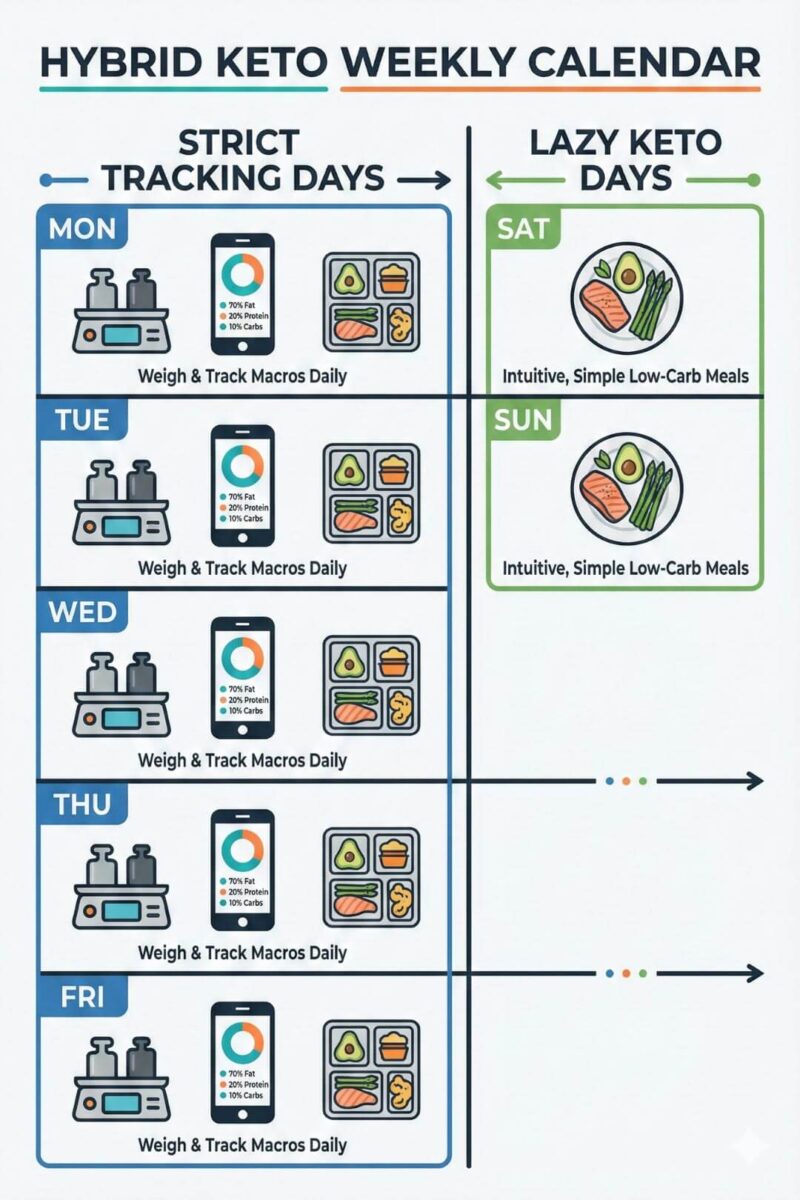
Strict Weekdays, Lazy Weekends
Popular hybrid strategy: Precision Monday through Friday for controlled, measurable progress. Relax on weekends while keeping carbs low but not tracking portions.
Builds in mental breaks. Social flexibility. No ketosis derailment.
Lazy with Occasional Check-Ins
Live the lazy keto life 90% of the time. But once monthly, track everything for 3-4 days. It’s routine maintenance for your eating habits. Catches portion drift before it becomes a problem.
Strict for Fat Loss, Lazy for Maintenance
Use strict keto during active weight loss phases—12 to 16 weeks. Hit your goal weight? Transition to lazy keto for sustainable maintenance.
You get the benefit of both approaches at the right times.
The Non-Negotiables: What Both Approaches Must Get Right
Whether you choose strict or lazy in the lazy keto vs strict keto decision, these pillars apply to both approaches.

1. Net Carbs are King
Both methods succeed or fail here. Period.
Look, you can track every macro with mathematical precision, but if you’re unknowingly eating 50g of carbs daily from sauces and “keto-friendly” packaged foods? You’re not in ketosis. End of story.
You must understand which foods are genuinely low-carb. Keep intake authentically low—under 20-25g net carbs daily. There’s no “lazy keto” if hidden carbs sabotage your efforts.
Learn the basics: Net carbs = Total carbs – Fiber – Sugar alcohols (usually). Above-ground vegetables? Generally safe. Below-ground vegetables like potatoes, carrots, beets? Higher carb.
2. Prioritize Whole, Nutrient-Dense Foods
A diet of processed keto bars, shakes, and packaged “low-carb” desserts won’t be healthy or satisfying long-term. Doesn’t matter if you’re tracking or not.
Build your plates around:
- Halal proteins: Chicken, beef, lamb, fish, eggs (no pork needed for keto success!)
- Healthy fats: Avocado, olive oil, coconut oil, ghee, nuts in moderation
- Above-ground vegetables: Spinach, broccoli, cauliflower, zucchini, peppers, leafy greens
Real food beats packaged food every time. Satiety. Nutrition. Results.
3. Manage Electrolytes from Day One
The “keto flu” doesn’t care if you’re doing lazy keto vs strict keto.
When you cut carbs, your body dumps water and electrolytes rapidly. Headaches. Fatigue. Cramps. Brain fog. All preventable.
The fix: Salt your food generously. Drink bone broth daily, especially Week 1. Consider a magnesium supplement—200 to 400mg daily. Get potassium from avocados and spinach.
Read our 24-hour keto flu relief guide for the complete electrolyte protocol.
4. Listen to Your Body’s Feedback
Are you losing weight steadily? One to two pounds per week after the initial water weight?
Do you have consistent energy throughout the day? Are you satisfied after meals without cravings an hour later? Is your sleep quality good?
This qualitative feedback often matters more than any ketone meter reading or macro percentage. Your body tells you if your approach is working.
5. Avoid These Common Mistakes
Don’t make the 11 keto mistakes that sabotage beginners: eating too little fat, over-consuming protein, ignoring electrolytes, eating too many nuts, or quitting during the adaptation phase.
Both lazy and strict keto can fail if you make these foundational errors.
Lazy Keto vs Strict Keto for Halal Eaters
Here’s something most keto guides miss: both approaches work perfectly with halal dietary requirements.
No pork needed for keto success. None.

Build your meals around:
- Halal proteins: Chicken thighs and breasts, ground beef, lamb chops, salmon, tuna, whole eggs
- Healthy fats: Olive oil, avocado, ghee (clarified butter), coconut oil, almonds, walnuts
- Low-carb vegetables: Spinach, broccoli, cauliflower, zucchini, cucumber, bell peppers
Lazy keto advantage for halal eaters: Simple shopping at your local halal butcher. Buy quality meat. Cook with good fats. Add vegetables. No complicated meal planning. No specialty ingredients. Your grandmother’s cooking methods—grilling, roasting, sautéing—work perfectly.
Strict keto advantage for halal eaters: Precise protein tracking ensures you’re getting optimal nutrition from halal sources without exceeding targets. Calculate exactly how much chicken or lamb you need daily to meet your goals while respecting your dietary values.
Both methods respect your dietary values while delivering weight loss results.
The keto community is diverse and inclusive. Your halal lifestyle fits perfectly.
💬 Join 500+ Keto Followers Who Made the Right Choice
Get weekly keto tips, halal-friendly recipes, and exclusive meal
plans in our free email community. Learn from others doing both
lazy and strict keto successfully.
We respect your privacy. Unsubscribe anytime.
Conclusion: It’s About Your Victory, Not a Category
The battle between lazy keto vs strict keto isn’t about finding a universal winner.
It’s about finding YOUR winner.
Your lazy keto vs strict keto choice? Pick whichever one you won’t quit after three weeks.
Strict keto offers a powerful, accelerated path for those who thrive on structure. Data. Precision. If you love tracking, optimization, and seeing measurable progress in numbers, this approach can be deeply satisfying and highly effective.
Lazy keto offers a peaceful, lasting path for those who need simplicity and mental freedom to stay consistent month after month. If you’ve failed diets before because they felt like punishment or a part-time job, this approach removes that friction.
Now here’s what matters most: consistency is your ultimate secret weapon for long-term weight loss.
The “better” method is almost always the one you can maintain without resentment. Without burnout. Without obsession.
Start where you are. Use the method that fits your life today. You can always adjust as you learn and grow.
The goal isn’t following a perfect keto protocol—it’s building a better, healthier relationship with food that gets you sustainable results.
Both lazy and strict keto can take you there.
Choose your path. Commit to it fully. Trust the process.
Ready to start? Check out our complete beginner’s guide to understand how keto works before diving into either approach.
Keto Style FAQs: Your Questions Answered
-
Is lazy keto vs strict keto better for beginners?
In the lazy keto vs strict keto debate for beginners, lazy keto wins almost every time. Why? Start by mastering one skill—keeping carbs under 20-25g daily—without the stress of tracking everything else. Once you’re comfortable with low-carb eating (usually after 2-4 weeks), you can add strict tracking if you want to optimize further.
Starting with strict keto often leads to overwhelm. Quitting within the first week. Learn how to start keto the simple way with our beginner’s guide.
-
Will I lose weight slower on lazy keto?
You might, especially in the first 2-4 weeks. You’re not controlling overall calories as tightly as strict keto.
However – and this is crucial – because lazy keto is significantly easier to stick with, many people lose weight more consistently over many months. This often leads to greater total weight loss over a 6-12 month period.
Consistency beats intensity for long-term results. Always.
-
Can lazy keto get me into ketosis?
Yes. Absolutely.
If you reliably keep net carbs under 20-25 grams per day, your body enters ketosis within 2-7 days. Metabolic law. The difference? You’re not using blood ketone meters to confirm it with data. You’re relying on the proven dietary principle.
You’ll know you’re in ketosis by how you feel: steady energy, reduced hunger, mental clarity.
-
I’m not losing weight on lazy keto. What should I do?
First, honestly double-check your carb intake. Hidden carbs sabotage more people than anything else.
Sauces. Salad dressings. Processed meats. Excessive nuts. A tablespoon of BBQ sauce can pack 12g carbs. Nuts are deceptively high—it’s easy to eat 200-300 calories in a “handful.”
If your carb intake is definitely under 25g? Try switching to strict keto for 2-3 weeks. The detailed data shows you exactly where your calories are coming from. Often it’s too much cheese, nuts, or fat bombs.
-
Is one method healthier than the other?
Not inherently. Health comes from food quality, not tracking method.
A strict keto diet of processed meats, artificial sweeteners, and packaged bars is far less healthy than a lazy keto diet rich in vegetables, wild-caught fish, grass-fed meat, and avocados.
Both approaches can be healthy or unhealthy depending on your food choices. Always prioritize whole, nutrient-dense foods regardless of your tracking preference.
-
Which is better for maintaining weight loss long-term?
Lazy keto wins here for most people.
Once you’ve lost the weight, the goal shifts from aggressive fat loss to sustainable maintenance. Lazy keto’s simplicity makes it a realistic lifestyle for years. Even decades.
Strict tracking tends to lead to burnout in maintenance phases. That said, some people genuinely enjoy tracking and find it grounding. If that’s you, strict keto maintenance can work too.
-
Can I do lazy keto long-term without health issues?
Absolutely, as long as you eat a variety of whole foods. Don’t rely heavily on processed “keto” products.
Many people follow lazy keto for 5, 10, even 15+ years successfully. The key? Maintaining awareness of carb content in foods without obsessive tracking. Eating plenty of vegetables for micronutrients. Periodically checking in with a doctor for blood work.
If weight loss stalls after several months, a 2-3 week strict tracking period helps recalibrate your portions and break plateaus.
-
Do I need to test ketones on lazy keto?
No. Not necessary.
Ketone testing is more common with strict keto because people want data validation. With lazy keto, if you’re keeping carbs under 20-25g daily, you’re in ketosis. Your body has no choice but to burn fat for fuel.
Save your money on test strips. Invest it in quality food instead.
-
Can I build muscle on lazy keto or do I need strict keto?
You can build muscle on either approach, but you need to be more conscious of protein intake.
Lazy keto can sometimes lead to under-eating protein if you’re not paying attention. If muscle building or body recomposition is a primary goal, either track protein strictly (keeping everything else lazy), or transition to full strict keto to ensure you’re hitting 0.8-1g protein per pound of lean body mass daily.
-
What if I want to try both approaches?
Perfect! The hybrid approach we discussed earlier is ideal.
Start with lazy keto for 4-6 weeks to learn the ropes. Curious about optimization? Hit a plateau? Do strict keto for 2-3 weeks to see exactly what you’re eating. Then return to lazy keto armed with better intuition.
Many successful keto followers cycle between approaches based on their current goals and life circumstances. There’s no rule saying you must pick one forever.
You don’t need to be perfect on keto
You need a plan that fits your life.
Takes just a few minutes. No guesswork. No extreme rules.
